
An EIR that actually gets you the model.
Most EIRs are copy-pasted out of PAS 1192 or written so vaguely that no contractor knows what to deliver, so they don't. This template forces every requirement down to a discipline, an LOIN, a CDE folder, and an acceptance gate, so the model that lands is the one you actually asked for.
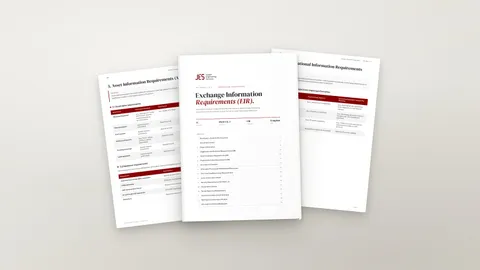




















Four files. One enforceable spec
-
01
EIR document template (Word).
The full EIR, structured to ISO 19650 Part 1. Pre-written clauses for purpose, milestones, exchange points, software, security, and acceptance, with prompts where your project-specific scope goes.
-
02
LOIN matrix per discipline (Excel).
Level of Information Need broken down by discipline and by stage, geometry, alphanumeric data, documentation. No more "LOD 400" as a single number that means nothing.
-
03
Delivery schedule template.
Information delivery plan tied to design and construction milestones. Who issues what, into which CDE container, by which date, pre-mapped so you can drop in dates and assignees.
-
04
Acceptance gate checklist.
The pass/fail checks we run on incoming models before they're accepted into shared. Geometry, naming, parameters, clash hygiene. If it doesn't pass, it goes back, no negotiation.
Built for the client side
Developer EIR.
You're commissioning a tower, a community, a hotel. You need a BIM spec your consultants and main contractor can't fudge, and that hands you a usable asset model at PC.
Asset-owner EIR.
You're inheriting models you'll have to operate. You need the FM data, the geometry hygiene, and the handover structure defined upstream, not negotiated at closeout.
Public-client EIR.
You're procuring under ISO 19650 or local BIM mandates. You need an EIR that's audit-defensible, mandate-aligned, and written in language a contractor can actually price.
Questions, answered
Is it really free?
What format are the files?
Can I edit and reuse it on my projects?
Will you spam me?
Can you help us implement it?
This is the EIR pattern we recommend to developer-side clients. ISO 19650-aligned, written for enforcement not theatre, the same structure we use to govern information delivery across our own live engagements.