
Coordination
From LOD 350 to fabrication-ready
Why "coordinated" models still cause site rework, and the handoff that fixes it.
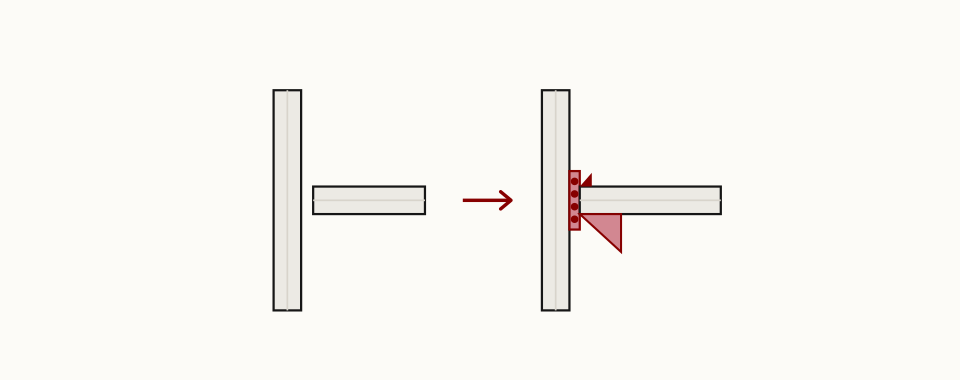
The model passed clash detection. The coordination sign-off is on file. Then the first spools arrive on site, and by the end of the week steel is going back to the yard to be re-cut. Everyone looks at coordination. Coordination was fine.
The failure lives somewhere with no owner: the handoff between design coordination and fabrication release. A model can be genuinely coordinated and still not be a thing you can build from, because those are two different standards answering two different questions.
What LOD 350 actually promises
LOD 350 is the coordination level in the BIMForum LOD specification. It takes LOD 300 and adds the parts that let the disciplines be checked against each other, the connections and interfaces to adjacent systems, the supports and hangers, the fittings and sizing, so the question it answers is "does everything fit together?" That is a multidisciplinary coordination question, which is exactly what clash detection tests, and a clean result means it was answered honestly across every trade.
Fabrication asks a different question: "can you order, cut, bend and hang from this?" That needs detail LOD 350 never promised, the actual manufacturer fitting rather than a generic family, penetrations agreed with structure, tolerances stated per assembly. A generic elbow fits beautifully in the model and does not exist at that size on the order sheet. And geometry is only half of it. A fabrication-ready element also carries the information the project asks for under ISO 19650, the classification codes and asset data a format like COBie captures, because a real product is ordered and tracked by its data, not its shape alone. How those information requirements are defined and exchanged is part 4 of our ISO 19650 guide.
Coordination answers "does it fit". Fabrication asks "can you build from it". Rework lives in the gap between the two questions.
The handoff nobody owns
Between coordination sign-off and the fabricator's first cut, the model crosses a contractual boundary, design team to trade contractor, often through a procurement step that strips context on the way. Because each side believes the other checked, release gets treated as a date the programme reaches instead of a state the package earns. The re-cut steel is what that assumption costs.
Release is a gate with named checks
We treat fabrication release the way we treat any other stage gate: a checklist closed per package, before any geometry leaves the model. The checks are unglamorous, which is the point, every one of them is a category of rework somebody has already paid for.
| Check | What it prevents |
|---|---|
| Real fittings, not generics | Connections specified to products that don't exist at that size |
| Supports and hangers modelled | Clashes that only appear when the trapeze goes in |
| Penetrations signed by structure | Core-drilling slabs that were never meant to be drilled |
| Tolerances stated per assembly | Millimetre geometry read as an installation instruction |
| Sheets reconcile to the model | The fabricator building from a drawing the model has moved past |
Who should run it
The gate works when it has one named owner with the authority to hold a package back. Who that is flexes with the project's delivery strategy, the BIM coordinator running the federation, the digital delivery lead, or the design manager, whoever sits where the design intent and the trade models meet. What matters is that the role is named before release, not which title holds it. On our delivery engagements the release check is part of the shop-drawing cycle: nothing is issued for fabrication until its package clears, and the checklist result is filed with the issue record so the decision is auditable later.
The cost of the gate is a day or two per package. The cost of skipping it arrives by truck, goes back by truck, and lands on whoever owned the assumption. If your last project re-cut steel that a "coordinated" model signed off, the fix is not better clash detection, it is naming the question your sign-off actually answered. The Golf Hillside Tower case study shows the release cycle running on a live package.
← All articlesJournal
Read next.
 5 min
5 min
The BEP subcontractors actually follow
The difference between a filed document and a working agreement is five sections.
Read 6 min
6 min
Zero clashes is not the standard
Zero hard-clash is not the deliverable and it is rarely the end state. Here is the tolerance, severity and gate regime we hold a federated model to before sign-off.
Read 6 min
6 min
QTO as the single source of truth for variations
When quantities come straight from the model, variations stop being arguments and become deltas.
Read 5 min
5 min
As-built from day one
Retrofitting an as-built at practical completion is a tax. Updating it weekly is a habit.
Read