
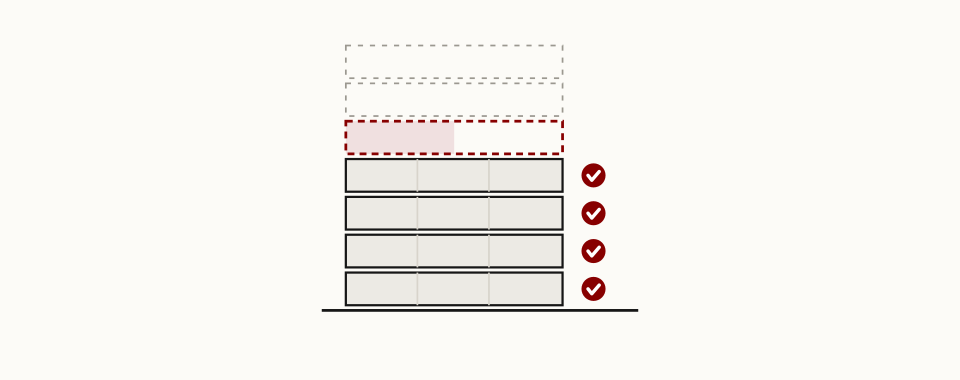
Handover
As-built from day one
Retrofitting an as-built at practical completion is a tax. Updating it weekly is a habit.
Three weeks before practical completion, someone opens the model for the first time in months. The job now is to reconstruct everything the site changed, from markups, photos, RFIs, and the memory of whoever is still on the project. The deliverable will say as-built. What it actually is, is an as-remembered.
A record is trustworthy in proportion to how close to the work it was made. That is the whole argument. Everything else is the practicalities of acting on it.
The retrofit tax
Assembling the record at the end costs three times. It costs money, collecting asset data after handover runs several times the cost of collecting it progressively during construction, because what was a five-minute update at the time becomes a site survey later. It costs time, operations teams inherit a remediation exercise that can run months while the building runs on guesswork. And it costs trust, which is the expensive one: nobody can say which of the season's changes made it into the model, so the FM team treats the whole record as suspect and re-verifies before relying on it. An as-built nobody trusts delivers nothing except contractual closure.
We know what the recovery looks like because we sell it. On Al Badia, construction-phase documentation gaps surfaced after the fact, and the asset information model had to be rebuilt retrospectively, site surveys, laser scans, equipment inspections, manufacturer records. It works, and it is the most expensive possible way to arrive at a record model.
An as-built assembled at the end is an as-remembered. The record is only as good as its distance from the work.
A weekly habit, not a phase
The alternative is not a heroic effort, it is a small one, repeated. The record model rides a cadence the project already has: the weekly coordination cycle. Site changes land in the model the week they happen, while the person who made the change can still point at it. Issues close against model geometry, not against an email thread. The model stays live on site instead of being archived after tender and resurrected at the end.
The data deepens as the project does. Design parameters are already there. Construction adds installed equipment, serials, manufacturer confirmations, installation dates. Commissioning adds test results and certificates. By handover the asset information is complete because it was never incomplete, each fact was recorded by the person who had it, in the week they had it.
What handover looks like as a by-product
When the rhythm holds, practical completion stops being an information event. The record model is at LOD 500 because it tracked the installation as it happened. The asset register carries the asset information the client specified, COBie or the broader asset information requirements set out in their own document, collected at source. O&M documentation links to the model elements it describes. The FM team starts operating on day one with information they can trust, because they can see when each fact was recorded and by whom, instead of inheriting a model that appeared in the final month claiming to describe the previous year.
The choice is not whether to pay for the record, the information has to be captured either way. The choice is whether to pay in five-minute increments while the facts are fresh, or in surveys and re-verification after they are gone. Our as-built documentation service covers both ends, including the recovery, for buildings where day one has already passed, and ISO 19650 Part 3 sets out what the operational side of that information is for.
← All articlesJournal
Read next.
 6 min
6 min
From LOD 350 to fabrication-ready
Why "coordinated" models still cause site rework, and the handoff that fixes it.
Read 5 min
5 min
The BEP subcontractors actually follow
The difference between a filed document and a working agreement is five sections.
Read 6 min
6 min
Zero clashes is not the standard
Zero hard-clash is not the deliverable and it is rarely the end state. Here is the tolerance, severity and gate regime we hold a federated model to before sign-off.
Read 6 min
6 min
QTO as the single source of truth for variations
When quantities come straight from the model, variations stop being arguments and become deltas.
Read