
Coordination
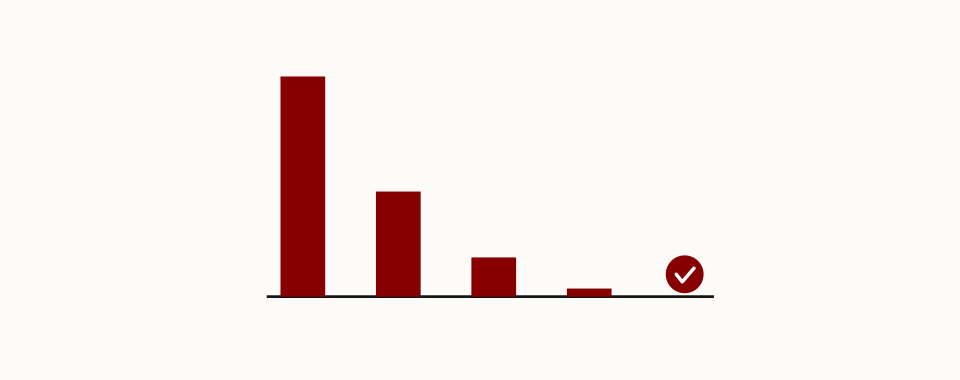
Clash detection to zero
Zero hard-clash is table stakes. Here is the tolerance standard we hold a federated model to before sign-off.
Any model can reach zero hard-clashes by Friday. Loosen the tolerance, dismiss the awkward results, and the report turns green. The number that gets emailed to the client is not the number that protects the site, and on a live coordination package the gap between the two is where the money leaks out.
So the count is not the standard. The standard is the regime that produces the count, the tolerances we run, the order we run them in, and the gate a model has to clear before anyone signs it off. Here is ours.
What zero actually means
Clash tolerance is the threshold below which the model treats an overlap as noise rather than a clash. We run hard-clash detection tight: the tolerance typically sits at 5–10 mm, just wide enough to filter the hairline overlaps that come from rounding in the authoring model, and no wider. The exact band is a project decision, set by the requirements and the modelling accuracy of the elements involved, tighter where the geometry is precise, wider where it has to be. That distinction matters: a two-millimetre kiss where a fitting rounds into a slab is modelling noise; a fifty-millimetre interpenetration is a duct running through a beam. Push the tolerance up to make the first disappear and you bury the second with it. Zero hard-clash only means anything when the threshold underneath it is honest.
The clashes that cost money are soft
Two services can miss each other by a clean millimetre and still be unbuildable. The pipe clears the duct, but the installer can't get a spanner between them, or the valve they need to reach every quarter is now sealed behind a cable tray. These are soft clashes: clearance, access and maintenance-envelope conflicts where nothing physically overlaps but the space still doesn't work.
We check them against the figures that actually govern, not a rule of thumb, the maintenance access each manufacturer specifies for its plant and valves, the clearance around insulated and lagged runs, the fire-separation distances where services cross a compartment line. Those come from the manufacturer's requirements, the project specifications and the applicable standards, because the access a chiller needs and the access a valve needs are not the same number. Ceiling voids, risers and corridor zones are where these bite first, because that's where the design tolerance has already been squeezed to nothing.
A model with zero hard-clashes and no clearance regime is a model that builds beautifully once and can never be maintained.
Not every clash is equal
A raw clash count treats a structural column through a riser the same as a sprinkler head 4 mm inside a tolerance band. We don't report a count; we report a register, triaged by severity, and we close it from the top.
| Severity | What it is | Action |
|---|---|---|
| Critical | Hard collision in primary structure or a main service run | Resolve before the model moves |
| Major | Clearance or access breach that blocks install or maintenance | Resolve and re-coordinate |
| Minor | Limited-impact overlap, local fix only | Log, fix, verify |
| Dismissed | Intentional connection or within true tolerance | Recorded with a reason, never silently deleted |
Order is part of the standard
We resolve by clash-set priority, not by whatever the software lists first: structure against mains, mains against branches, then detail. Hard clashes clear before clearance checks even run, because a clearance result against an element that's about to move is wasted effort. Run the passes out of order and you re-coordinate the same zone three times.
The standard is a gate, not a number
All of this lives inside the CDE, not in a one-off report. A model earns its way from Work in Progress into the Shared area to be coordinated and clashed, and it only reaches Published, the state anyone is allowed to build from, once the severity register is closed to standard. The clash regime is the lock on that gate. The CDE states and gates themselves are covered in part 2 of our ISO 19650 guide.
We test the engine, we don't trust it blind
A clash result is only as good as the geometry test behind it. Before JES trusts a single automated result, the detection engine is validated against a battery of deliberately nasty edge cases, ducts crossing pipes at the principal-axis tie, walls rotated thirty degrees in plan, elbows tilted out of the horizontal, parallel runs fifty millimetres apart that must not report. If the engine calls those correctly, the clean results are worth believing. That validation is the difference between a green report and a coordinated model.
The deliverable
So the line we hold isn't "zero clashes." It's a federated model the site can build from without raising a single RFI about something that was visible in the model the whole time. Zero hard-clash is where that work starts. The standard is everything between there and the gate. For what that regime looks like on a live multi-trade package, see the Dubai Metro Blue Line case study.
← All articlesJournal
Read next.
 6 min
6 min
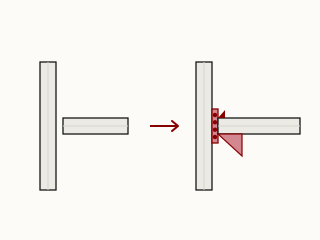
From LOD 350 to fabrication-ready
Why "coordinated" models still cause site rework, and the handoff that fixes it.
Read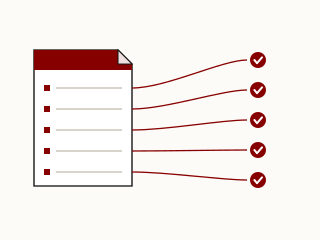 5 min
5 min
The BEP subcontractors actually follow
The difference between a filed document and a working agreement is five sections.
Read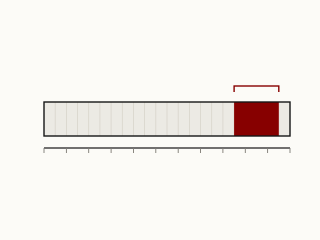 6 min
6 min
QTO as the single source of truth for variations
When quantities come straight from the model, variations stop being arguments and become deltas.
Read 5 min
5 min
As-built from day one
Retrofitting an as-built at practical completion is a tax. Updating it weekly is a habit.
Read